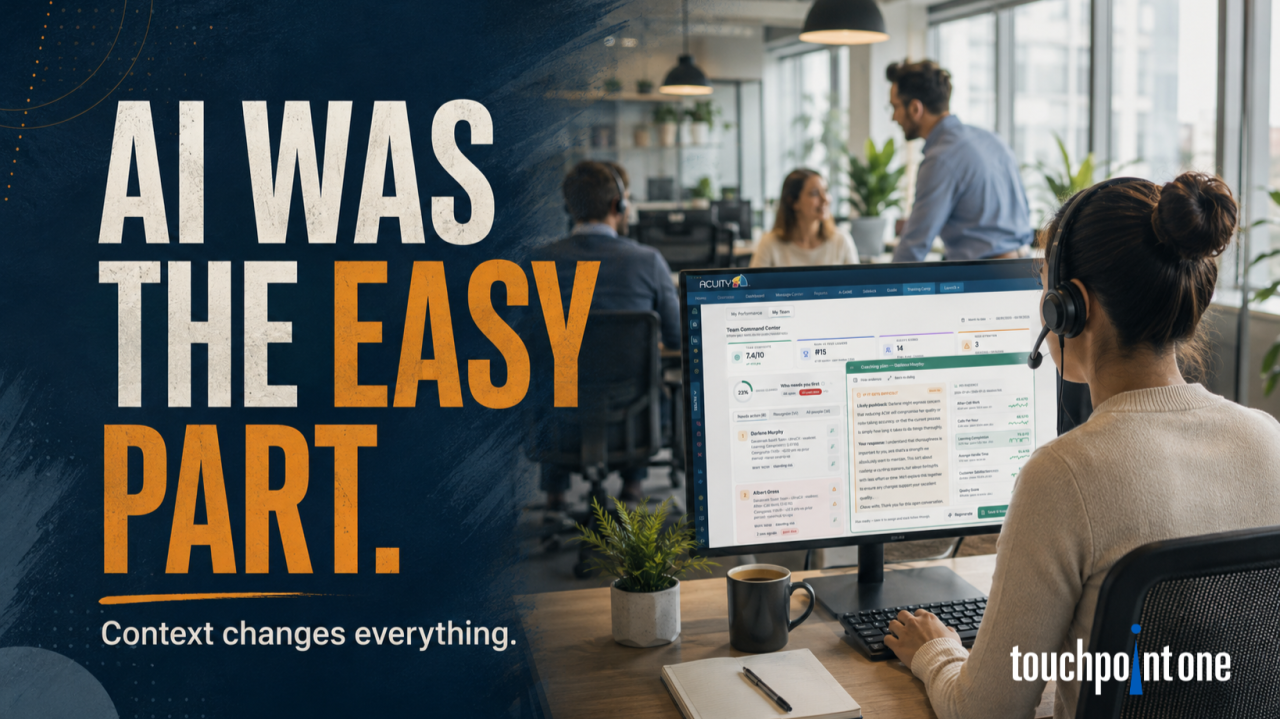
That may be one of the more important realities emerging as AI moves deeper into CX operations.
The technology is moving extraordinarily fast. Models keep improving. Conversations are increasingly easy to capture, transcribe and analyze. New AI capabilities can be added to software platforms at a pace that would have been unimaginable a few years ago. But something else isn’t moving nearly as fast: the organization.
Vendors can add AI functionality far faster than customers can reorganize their processes, data, knowledge and people around it. Increasingly, I think that is where the real work is.
Consider the customer conversation. It is extraordinarily rich data, and AI can consume it largely as it occurred. Give a capable model the interaction and it can summarize it, classify it, analyze it and identify an enormous range of signals. Now give that same model an employee’s AHT. Is 487 seconds good? Maybe.
Good compared to what? For which contact type? At what tenure? Against what target? How important is it relative to quality, FCR or CSAT? Is lower necessarily better? What behaviors influence it? What should a supervisor do about it? The number isn’t the context. The organization’s definition of the number is the context.
Knowledge presents a similar challenge. Having thousands of documents doesn’t mean you have effective knowledge management. Knowledge has to be organized, governed, maintained, versioned and made relevant to the person, situation and moment in which it is needed.
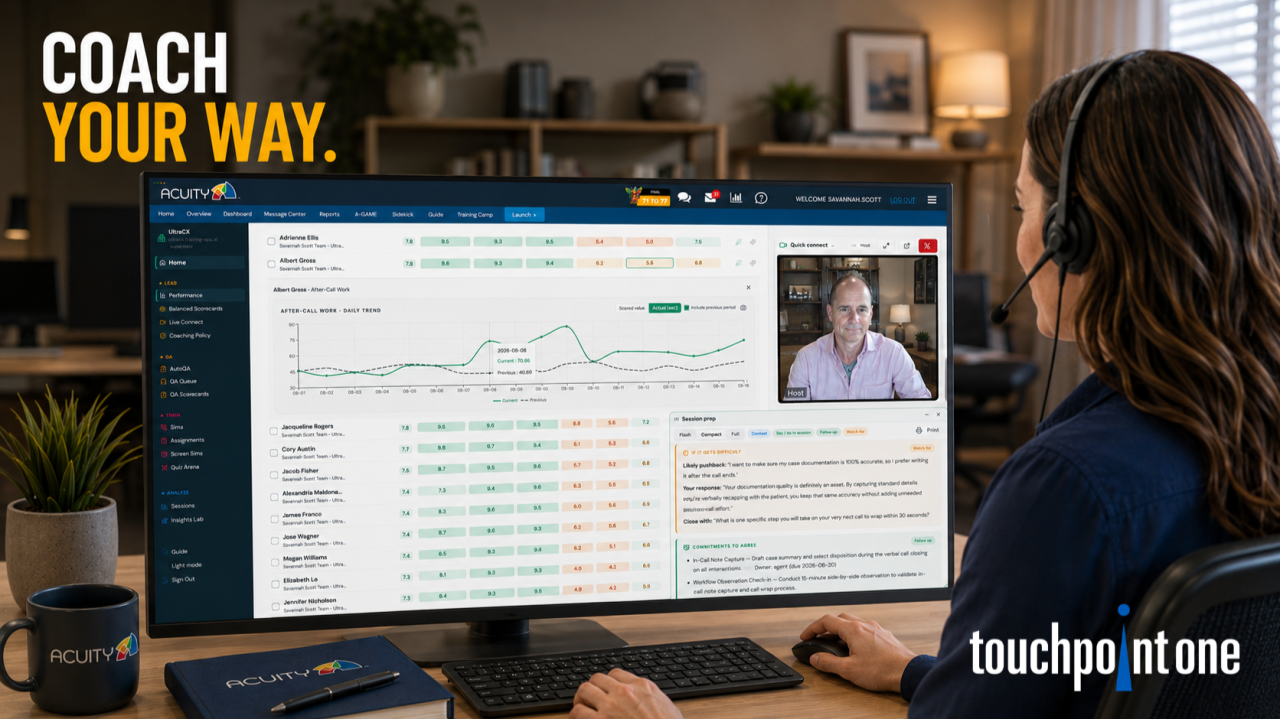
Performance management requires much of the same heavy lifting. KPIs must be defined. Data from different systems must be assimilated. Targets and relationships must be established. Stakeholders must agree on what matters and what good looks like. Processes must support it. People must adopt it. AI doesn't eliminate any of this. It makes getting it right more valuable.
I see two historically different sides of the CX technology market increasingly moving toward one another. One side has the conversation: the incredibly rich record of what happened between a customer and an organization. The other has the organizational context needed to understand what happened: knowledge, performance definitions, quality standards, policies, processes, employee history and the countless business-specific rules and measures that make one operation different from another.
AI needs both.
Conversations provide evidence. Knowledge provides truth. Performance management provides meaning. AI provides scale.
Whether all of that ultimately comes from one technology stack or an ecosystem of specialized platforms may matter less than our ability to bring the context together.
Because the constraint on enterprise AI isn’t access to intelligence. It’s organizational readiness. And it has been from the beginning.
For a while, AI dazzled us with the possibility that AI-enabled solutions might somehow be easier to implement, perhaps even approaching turnkey. We know better now. The technology may be easier to access than ever, but organizations still have to define what matters, organize and govern the underlying context, align stakeholders, establish processes and manage change.
Had that distinction been clearer from the beginning, a lot of organizations might have saved considerable money, time and cycles.
Coming from the data-intensive world of performance management, this has always been part of TouchPoint One’s DNA. Successful implementations require more than technology. They require alignment across operations, IT, quality, training, HR, finance and other stakeholders around what matters, how it is measured and what people should do with it.
AI raises the stakes, but the discipline isn’t new. AI capability is accelerating faster than organizational readiness. The opportunity now is to close that gap: organize the context, align the organization and put AI to work against a foundation everyone can trust.
Because deploying AI without sufficient context doesn’t just risk getting something wrong. It creates the ability to scale what’s wrong at machine speed.

“Acuity has made life so much easier for the leadership team! Having a balanced scorecard is a necessity in our environment.“
- Brandi Stadie, Senior Director of MTM Contact Center Operations, Phoenix, AZ
“With TouchPoint One's advanced platforms and expertise, we've seamlessly integrated gamification into our performance management, boosting employee engagement and efficiency.“
- Mark Wilson, Chime Solutions CEO
“We are saving ourselves so much time and so many headaches. It is just a better way to work.”
- Tereasa M. Vukanovich, Manager, Regulatory Compliance & Audit