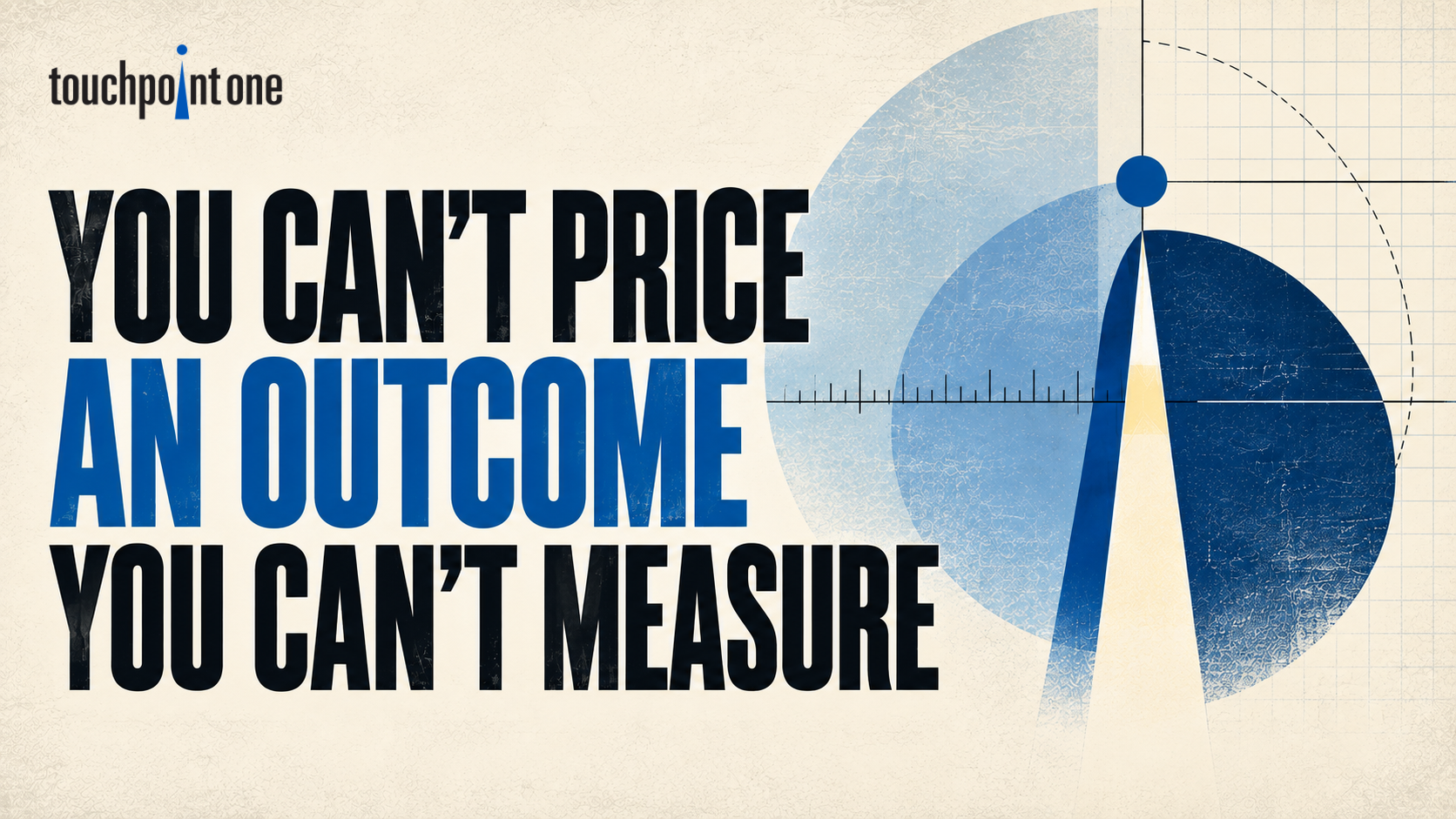
Outcome-based pricing was a recurring topic last week at Outsource Consultants BPO Evolution Summit in Dallas. It's not a new idea. Salespeople have lived with outcome-based compensation forever: produce the result, get paid for it.
What's changing in BPO is where the model is being applied and why. Buyers are increasingly asking providers to price around results rather than labor. At the same time, BPOs are using outcome-based models to demonstrate a more modern service delivery approach, particularly as the mix of people and AI continues to evolve. Instead of selling a fixed number of people, the BPO can increasingly sell an outcome and determine the best combination of people, process and technology to deliver it.
That sounds straightforward. Measuring it isn't.
Before a BPO can price an outcome, the client needs to define what good performance actually means. That usually shouldn't be a single metric. Lower AHT isn't necessarily better if FCR or CSAT suffers. Higher sales aren't necessarily better if quality or compliance declines. Lower cost isn't much of an accomplishment if the customer experience deteriorates with it.
This is exactly what balanced scorecards were designed to address. The measures, targets, scoring curves and weights establish a holistic definition of performance. Ideally, the client already has enough historical data to establish a credible baseline. If they don't, that needs to happen first. Without a baseline, there's no objective basis for determining what constitutes a fair and reasonable outcome, much less what someone should be willing to pay to achieve it.
For the BPO, that historical performance becomes extremely valuable during the pursuit. Take the client's established performance framework and apply proposed pricing structures to the actual results from the previous 12 months. What would the economics have looked like if the BPO simply maintained the client's historical performance at a lower delivery cost? What if performance improved? A base price could be tied to maintaining the historical balanced outcome, with progressive incentives as performance moves into higher bands. Downside risk could be modeled the same way.
Now the BPO can quantify the risk and reward before putting revenue and margin behind the proposal. More importantly, the exercise can inform the delivery strategy. Historical performance can reveal where there is headroom, what it may take to capture it, where process changes can help, where AI might lower delivery cost or improve performance, and where people remain essential. The BPO can formulate its proposal with a much clearer understanding of both the economics and the execution required to make them work.
Once the engagement begins, the same performance framework becomes the shared source of truth. The client can see whether the outcome it purchased is being delivered. The BPO can see what's driving the result and where intervention is required. And because the outcome is balanced, neither side has to pretend that optimizing one KPI necessarily represents success.
The assumptions won't remain static. Contact mix, customer behavior, policies and AI capabilities will change. When they do, the performance model can be recalibrated based on data rather than competing opinions about where the goalposts should move.
Enterprise buyers aren't exactly suffering from a shortage of ambitious AI promises. Depending on who's presenting the deck, agentic AI may transform the contact center, dramatically reduce labor, or make much of it unnecessary altogether.
Maybe. The harder question is how much, how quickly, for which interactions, and at what risk to the customer experience.
This is where an outcome-based BPO can offer the client something particularly valuable: don't make that bet yourself.
Establish the performance baseline and the outcome you expect, then give the BPO responsibility and economic incentive to continuously determine the right combination of people and AI to deliver it. If AI can safely eliminate 5% of the labor, capture it. If it's 20%, capture that. If it eventually becomes 80% for certain interactions, capture that too. The point isn't to predetermine the answer. It's to let performance determine how aggressively to proceed.
Human-only, hybrid human + AI, and AI-only interactions can all be measured against the same performance framework. Automation isn't successful simply because it removes labor. It has to produce the result the client agreed to buy. The BPO is rewarded for finding efficiencies that verifiably work, while the balanced outcome provides the guardrail against "transformation" that simply lowers cost by degrading service.
In effect, the client transfers much of the experimentation, optimization and execution risk to a partner whose economics are tied to getting the answer right.
Think of it somewhat like a managed investment portfolio. Establish the benchmark, give the manager an incentive to outperform it, and give them latitude to determine how best to allocate the assets. Then measure the result continuously against the benchmark and agreed risk parameters.
The objective isn't simply to use more AI. It's to capture as much of the economic upside of AI as the data supports without blindly accepting the operational and customer risk that can come with it. For CEOs, CFOs, technology leaders, procurement and operations, that's a very different proposition from choosing between "people" and "AI." It's asking a partner to continuously find the best combination of both, with its economics aligned to yours and the gauges in place to know whether it's working.
There's another benefit that has little to do with whether the parties ultimately choose outcome-based pricing. A BPO that brings this capability and methodology into the pursuit is demonstrating how it intends to run the business before it ever wins it.
Start with the client's performance history. Establish the baseline, simulate the economics, quantify the risk, identify the opportunity and show how you'll manage toward the result. Then decide together whether outcome-based pricing actually makes sense. It may or may not. Either way, the BPO has demonstrated a level of data, analytics and operational maturity that can differentiate it from competitors.
And when that capability is part of a broader AI-native performance management and employee engagement strategy, the value doesn't stop with calculating an outcome. The same performance foundation can inform better hiring, training and coaching; align incentives and engagement; guide the use of AI; and drive continuous improvement across the operation.
The underlying principles aren't new. Balanced scorecards have supported performance-based compensation for decades. What's changing is where we're applying them.
As BPOs take greater responsibility for delivering business outcomes, performance management moves upstream. It helps establish the baseline, model the economics, quantify the risk, manage execution and provide both parties with a shared measure of success. That's a much bigger job than reporting how the operation performed.
Outcome-based pricing may be the catalyst. Better CX performance management is the larger opportunity.
TouchPoint One helps enterprises and BPOs turn contact center performance data into better business outcomes. Its Acuity platform provides a shared performance management foundation for balanced scorecards, analytics, coaching, employee engagement, incentives and AI-driven performance improvement.
Acuity War Room extends that foundation into performance strategy modeling and simulation. Enterprises, BPOs and their partners can use historical performance data to model outcome-based pricing, workforce incentive compensation, human + AI delivery strategies and other performance-based plans; evaluate risk and reward before committing; and use the same performance framework to measure and manage the strategy once deployed.
Model the strategy. Measure the outcome.