A recent job post from Deloitte caught my attention this morning. The firm is recruiting a Digital AI Performance Manager to oversee the operational performance, quality, governance, and continuous improvement of AI-powered digital agents supporting its Global Contact Center.
One sentence in particular stands out:
"This position serves as the operational owner of digital agent performance, applying the same rigor used to manage human agent quality and effectiveness."
After years of investment in AI technologies promising to transform contact center operations, one of the world's leading professional services organizations is seeking someone to manage the performance of its digital workforce. Not build the AI. Not sell it. Manage its performance.
This is a clear indication of where the industry is heading.
For decades, contact centers have relied on performance management disciplines to improve productivity, quality, workforce morale, customer satisfaction, and operational efficiency. Scorecards, quality monitoring, coaching, analytics, calibration, and continuous improvement are familiar territory.
Now those same disciplines must extend to digital agents, with new measures including containment, response accuracy, escalation effectiveness, hallucinations, compliance, and knowledge quality. But there's a bigger challenge - the modern contact center isn't simply managing human agents and AI agents independently. It's managing the outcomes they produce together. A customer interaction may begin with AI, transfer to a human agent, involve AI assistance throughout the conversation, and conclude with automated follow-up.
Who owns that outcome? How is performance measured? Where did the process succeed or fail? And what needs to improve?
Managing each component in isolation won't answer those questions. Worse, it can create competing priorities, obscure accountability, and reward improvements in one area that actually undermine performance elsewhere. Without a unified view, organizations risk optimizing individual parts of the operation at the expense of the customer experience, operational efficiency, and ultimately, business results.
Contact centers increasingly operate across three models:
Human-only: Traditional agent performance, quality, productivity, and customer experience.
AI-only: Digital agent effectiveness, accuracy, resolution, reliability, compliance, and cost.
Human + AI: Combined performance, handoff effectiveness, assisted productivity, end-to-end resolution, and customer outcomes.
Each requires specialized metrics and management practices. But all three must ultimately be accountable to common business objectives. An AI agent achieving exceptional containment rates means little if customers repeatedly contact the organization to resolve the same problem. Likewise, reducing human handling time provides limited value if quality deteriorates or downstream costs increase.
Optimizing individual technologies isn't the same as optimizing business performance. That distinction becomes even more consequential as organizations embrace outcome-based pricing and hybrid service delivery.
Deloitte's job description identifies the responsibilities of managing AI performance. But even the most capable manager needs the right infrastructure to execute them. The challenge isn't simply collecting data or building dashboards. It's connecting performance measurement to the actions that improve results, across systems and operating models.
This is precisely what TouchPoint One's Acuity platform was built to do. Acuity unifies operational data and integrates balanced scorecards, AI-powered quality assurance, coaching, analytics, gamification, employee engagement, and continuous improvement into one performance management environment. Its technology-independent architecture provides a foundation for managing human, AI, and hybrid performance together.
Acuity goes beyond showing managers what happened. It helps them diagnose why, prioritize interventions, engage and coach people, and measure whether improvements stick. AI agents may require workflow or knowledge optimization rather than human coaching, but the management cycle remains the same: measure, diagnose, act, and validate. The objective isn't simply to know whether AI is working. It's to know whether the entire operation is performing better because of it, and what to do next when it is or isn't.
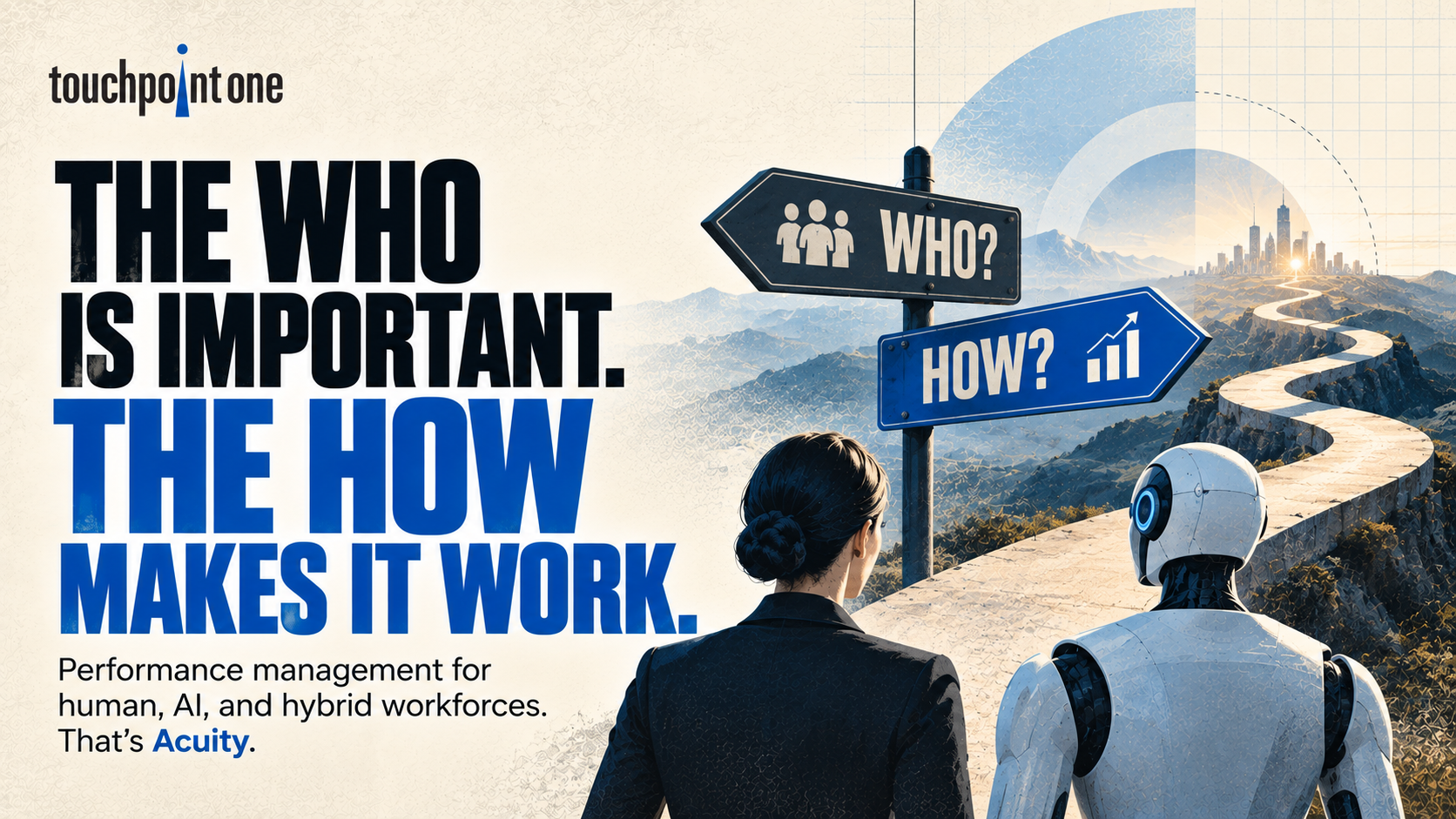
Deloitte's hiring initiative is an important signal. Organizations are beginning to formalize accountability for AI performance, much as they've done for human workforces for decades. Hiring the right performance manager answers the who. Equipping that person with an integrated platform to measure outcomes, identify problems, and drive improvement answers the how. Without both, accountability is an aspiration rather than an operating discipline.
AI is changing who, or what, performs the work. It isn't changing the need for operational accountability. The future of contact center performance management isn't human or AI. It's human, AI, and everything in between. That's the future Acuity was built for.
TouchPoint One provides Acuity, an AI-powered contact center performance management platform that unifies operational data, performance analytics, knowledge, training, quality management, coaching, and workforce engagement to help organizations improve measurable business outcomes.
The workforce is changing. Is your performance management strategy keeping pace? Discover what's possible with Acuity at touchpointone.com.
Greg Salvato is CEO of TouchPoint One and a member of the Forbes Technology Council. He works with contact center leaders to improve operational performance, employee engagement, and customer experience through technology, analytics, and performance management innovation.